Professional noise investigation,
delivered to your home
Persistent unexplained noise can be exhausting, especially when others cannot clearly hear or explain it. We help you detect, document, and identify sound disturbances so you can move toward a solution.
Find out:
- whether the noise can be objectively verified
- whether the disturbance may exceed current norms
- what kind of source is most likely causing it
- what the next sensible step toward a solution could be
Receive the kit
We ship the measurement kit with simple instructions.
Monitor in the affected room
Place it where the disturbance is most noticeable, let it monitor for up to two weeks. Log events with your impressions and remarks directly in your browser during the campaign.
Get a clear assessment
Return the kit with the included shipping label and review suspicious nights, marked events, and recurring patterns in your browser.
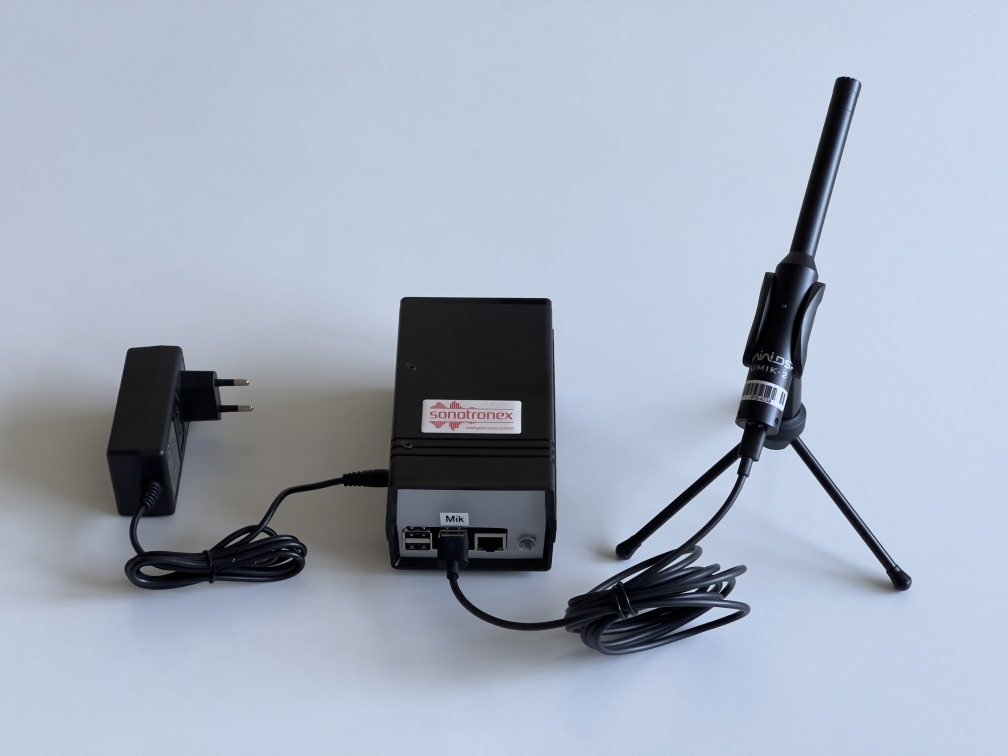
A compact, easy-to-use measurement system
|
High-quality measurement microphone Low self-noise (16.5dBA), calibrated to 0.1 dB accuracy, with coverage from 12.5 Hz to 20 kHz (with option down to 3 Hz) |
|
|
Accurate timekeeping Temperature-compensated clock |
|
|
Backup battery Keeps logging during power cuts up to 4h |
|
|
Local data storage Data is stored locally on the device during the campaign |
|
|
Wireless disabled Wi-Fi and BLE permanently disabled |
Delivery and return by Swiss Post
No complicated setup
Continuous monitoring for up to two weeks
Calibrated professional measurement
Clear findings, not just raw data
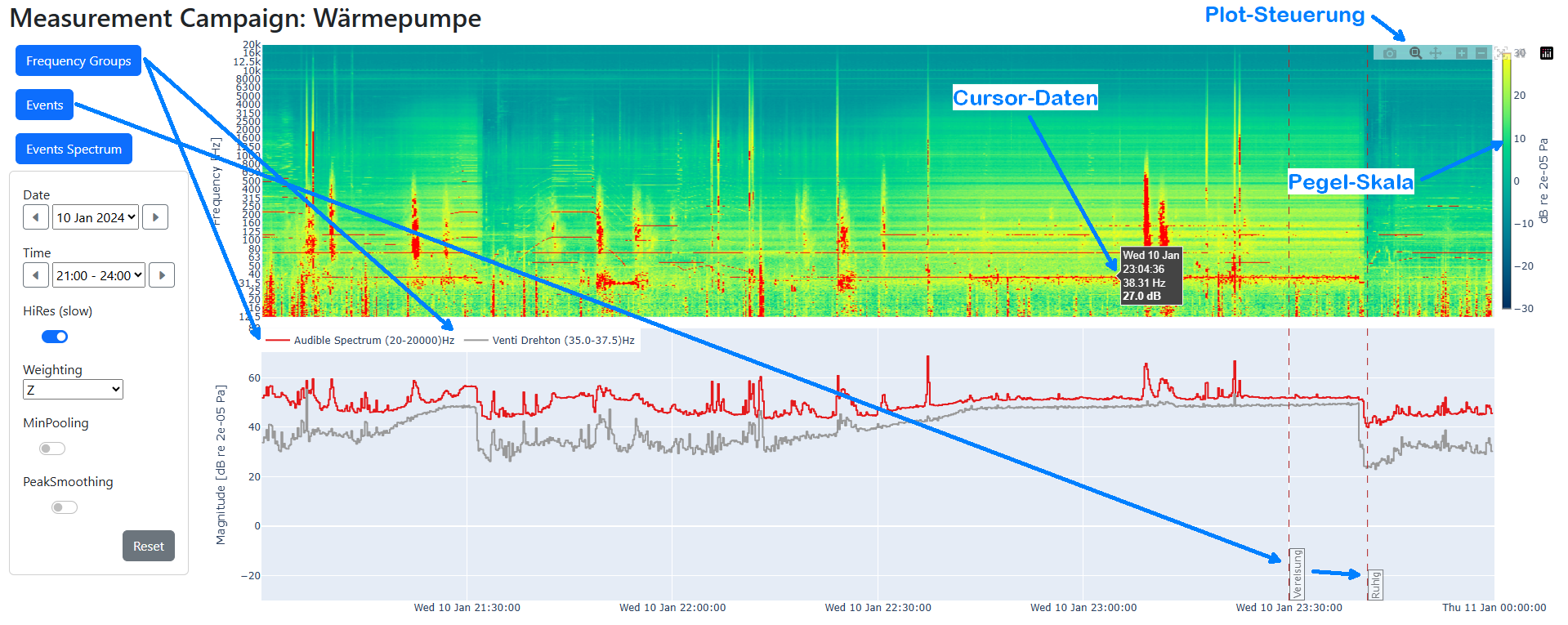
We turn long-duration measurements into clear visual evidence that shows when the disturbance appears, how it changes over time, and which source pattern it most closely matches.
- See when the disturbance starts, stops, and repeats
- Compare suspicious periods across days and nights
- Understand whether the sound is steady, intermittent, tonal, or irregular
- See which source pattern the measurements are most consistent with
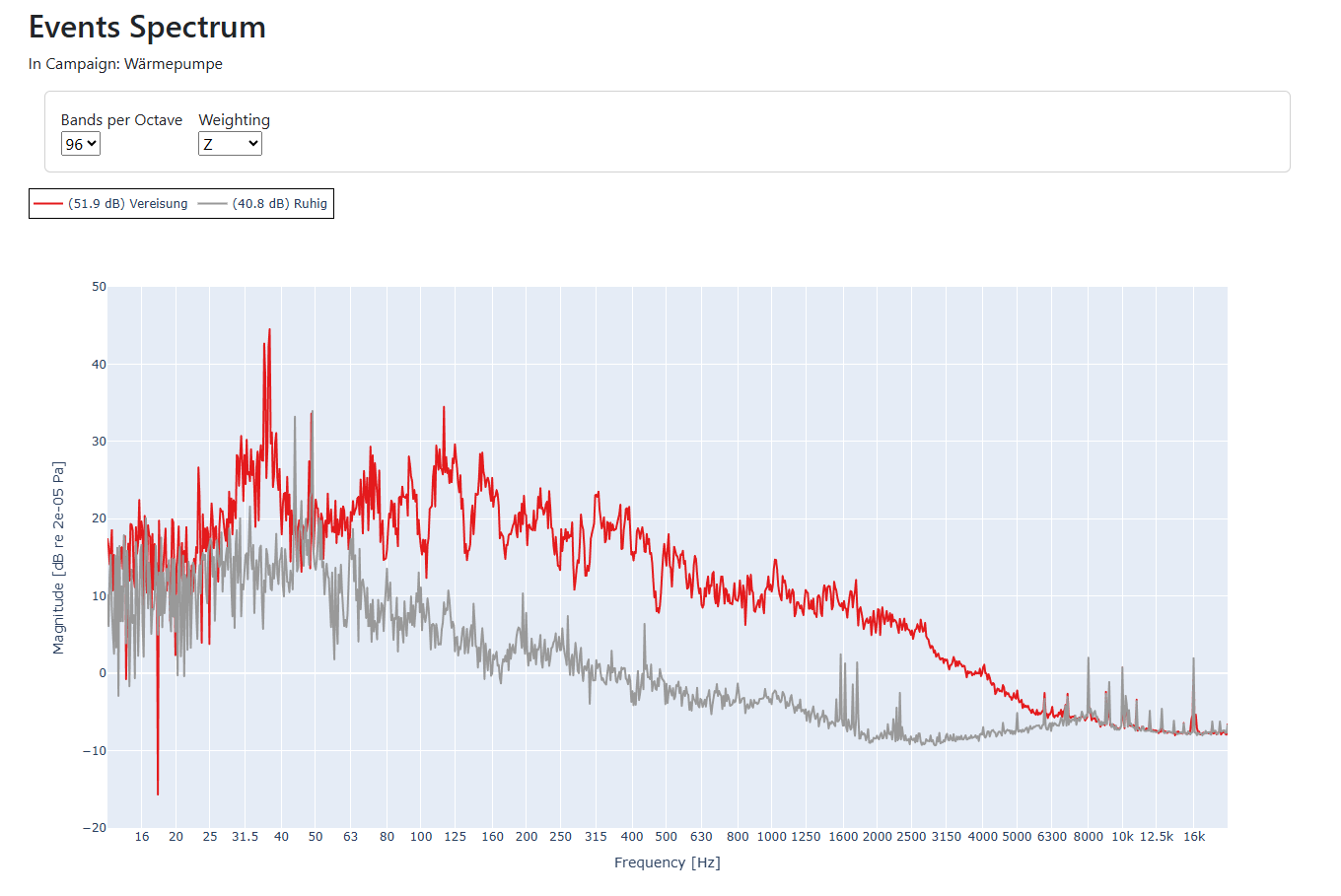
See very fine tonal detail
Sonotrazer uses exceptionally fine frequency analysis, with up to 96 bands per octave. This reveals very fine tonal components and subtle frequency changes that most common tools cannot clearly identify.
Hear an impression of the measured sound
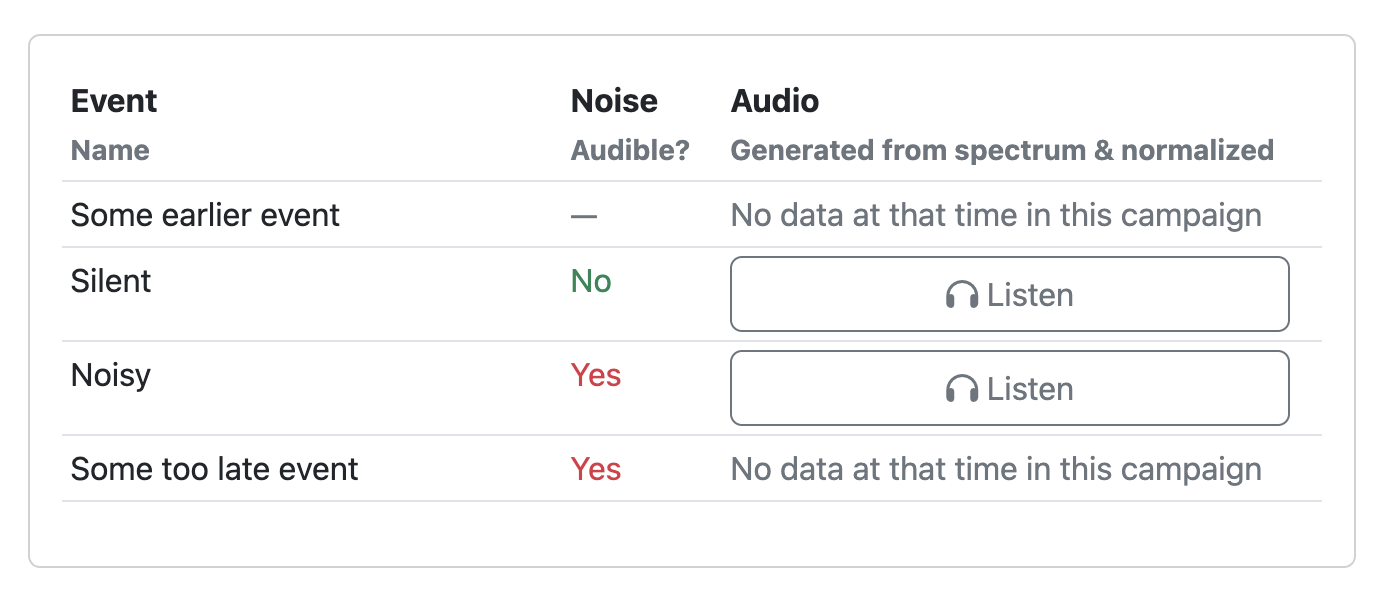
For selected events, Sonotrazer can generate a listenable impression of the steady sounds measured at a given moment in time. This can help pinpoint a specific disturbance, hear it again later, or let others hear it through headphones.
Identify what is most likely behind the noise
Recurring noise often leaves a recognizable timing and frequency pattern. By comparing those patterns, we can assess what type of source the disturbance is most consistent with.
This does not always identify one exact machine or location, but it can often narrow the problem to the most likely source family.
When Sonotrazer is most helpful
Nighttime disturbances that are hard to prove
Low-frequency hums, drones, or vibrations
Noise that comes and goes, so even a short expert visit may miss the moment it happens
Noise whose source is unknown and hard to locate
Situations where clearer evidence may help a complaint move forward
Particularly sensitive hearing at low volumes
Difficult home noise problems are often intermittent, low-frequency, or easy to miss during a short visit. A phone app can hint at a problem, but it usually cannot document it reliably enough for a serious investigation.
| Point | Professional measurement | Phone app |
|---|---|---|
| Calibration | Regularly calibrated microphone | Varies by phone and app, you would need an adapted calibrator |
| Low-frequency reliability | Better for hums, flat and known low-frequency response | Varies by phone, often limited or uneven frequency response that is optimized for voice |
| Self-noise | Better at revealing weak sounds | Higher instrumental noise due to much smaller form-factor, can mask subtle disturbances at higher frequencies |
| Long-term stability | Consistent over days and nights from a fixed measurement position | Less reliable for long monitoring and changes with handling and placement |
| Evidence quality | Useful for documentation and follow-up | Useful mainly for rough indication |
Calibrated, stable long-duration measurement gives a firmer basis for judging whether a disturbance may be relevant under current norms and worth formal follow-up.
A short on-site visit can be valuable, but difficult home noise problems often appear only at certain hours or on certain days. If the disturbance does not occur during the visit, even an experienced expert may leave without capturing it.
| Point | Sonotrazer | Expert visit on site |
|---|---|---|
| Chance of catching the disturbance | Monitors continuously for up to two weeks and captures recurring patterns across days and nights | Limited to the visit window and may miss the relevant occurrence |
| Cost as a first step | More cost-effective first step when the source or timing is still unclear | Significantly more expensive and less efficient if no clear event occurs during the visit |
| Evidence basis | Consistent fixed-position measurement over time | Valuable expert judgment, but often based on a short snapshot |
| Formal legal status | Informative calibrated measurement for investigation and follow-up, but not a formally accredited legal measurement result | With accredited measurement equipment and the appropriate formal method, it can in some cases produce a legally valid result with value in court |
| Best use | Strong first step to document whether a recurring disturbance exists and when it appears | Often more useful later, once measurements suggest where and when to investigate more precisely, or when a formal accredited measurement may be needed |
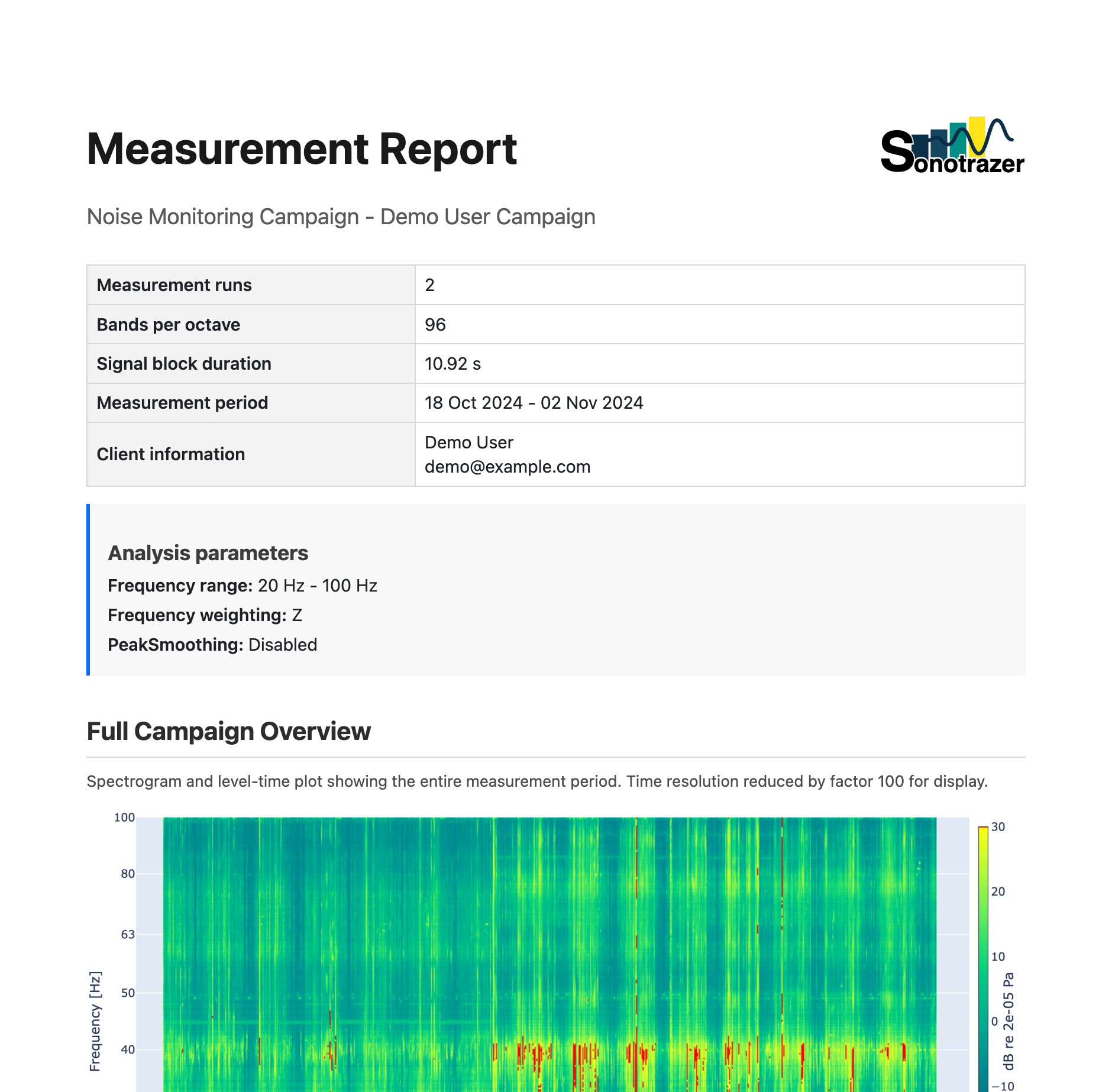
Shareable PDF report for evidence and follow-up
Measured data visuals and selected analysis results in one report, so the evidence can be communicated more clearly to a landlord, property manager, installer, neighbour, or follow-up expert.
- Campaign summary and full measurement overview
- Daily detail pages for the selected days
- Events table with marked noise events
- Selected frequency-region analysis over time
- Spectrum comparisons at the event times
Possible outcomes and next steps
Likely source identified
The measured pattern is most consistent with a specific source family, such as ventilation, heating equipment, traffic, or nearby industrial machinery.
Next step: Targeted follow-up with the relevant landlord, installer, building manager, or operator.
Disturbance confirmed, further detective work needed
The investigation captures and documents one or several relevant patterns, but additional work may still be needed to determine which one is actually causing the disturbance.
Next step: Use the results as objective evidence, compare them with site observations and user-marked events, and if needed plan a more targeted follow-up investigation.
No relevant external source found
If no meaningful external disturbance pattern is found, that can also be an important result. In some cases, it may justify exploring non-environmental or medical causes with the appropriate professional.
Next step: Reconsider other explanations instead of continuing to search only for an external technical source.
Measurement + Expert Support
- Shipping and return label included
- Noise data recorded over up to 2 weeks
- Review suspicious nights, marked events, and recurring patterns in your browser
- Shareable PDF export of measured results
- Personalized analysis by an experienced acoustic engineer at Sonotronex
- Assessment of the most likely source category
- Guidance on the next sensible steps
- Individual 1:1 session to review your data and explain the results
Privacy by design
- No replayable speech or private conversations are stored
- Wireless interfaces remain disabled during use
- Data is stored locally on the device during the campaign
- User account with two-factor identification
Stop guessing what you hear
Get clearer evidence and a better basis for the next step.